New Heathens
27Oct/110

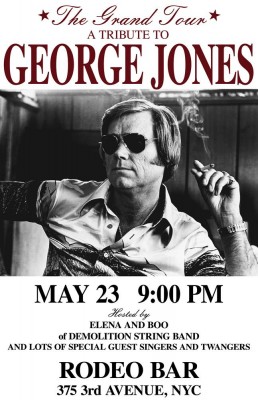
Live at Hank’s Saloon This Sunday, 6 p.m.

Me. Undead. Solo. Right after my great friends in the Early Grace Band.

Hank's (Rootin' Tootin') Saloon

46 3rd Avenue on the corner of Atlantic Ave. in Brooklyn

2, 3, 4, 5, B, or Q to Atlantic; D, M, N, R to Atlantic Ave. & Pacific Street.

6 p.m.

FREE!

Remember, Hank's Saloon is about the most classic honky-tonk/dive New York City has left; you're gonna' miss her when some developer ponies up $4 million and turns her into a ghost...


17Oct/110

Death by Avocado

Went out to hear an old friend play music last night and had to tell the lady taking fivers at the door that I was there to see "Death by Avocado." What is "Death by Avocado?" I'm not sure exactly, but it's the name my buddy said he had to use for some reason relating to international espionage.

We got to talking about a certain music business service that we both paid for around the times our last albums were released. He told me that for this service he paid a whopping $15,000 and got absolutely nothing.

"Holy guacamole!" I said. "You paid 15 grand and didn't get anything? I didn't get anything either, but I only paid $1,500!"

It was the first time in my music "career" that I felt like I got a really, really good deal. I got the exact same nothing that he did, only I paid ten times less. Bully for me, right?

Maybe that's what Death by Avocado means.

7Oct/111

Consider Sending a Note re: Montana Buffalo

UPDATED 10/18/11: Finally one group of people raised their voices at a public meeting last night in Glasgow, MT to support the bison restoration plan: Native Americans. When Fort Peck tribal members started to talk about traditional uses of buffalo, a third of the people who oppose the plan -- mainly farmers and ranchers -- stood up and walked out.

Holy public outcry, Batman! Montana Fish, Wildlife and Parks held two meetings this week to solicit public feedback on their plans to relocate 40 bison to four different sites in the state and local reaction bordered on the histrionic.

"This is not the 1800s," retiree Bill Mattice, of Garrison, MT, shouted at FW&P regional supervisor Mack Long Wednesday night. “Stay out of the buffalo business!”

On Thursday night Toole County commissioner Allan Underdal expressed fear that a buffalo might escape its pasture and wander onto a golf course! State Representative Mike Miller cried that the buffalo plan is, "a disaster waiting to happen that will destroy lives." Online commentators, responding to the newspaper stories, called bison “range maggots” that “just eat and poop.”

Range maggots on golf courses! A vision of the apocalypse!

I thought it might be wise to temper this hysteria with some additional reporting.

Here’s the background. Montana Fish, Wildlife and Parks quarantined about 120 disease-free bison that wandered out of Yellowstone National Park in the winter of 2005-2006 and rounded them into pens in Corwin Springs along Highway 89 just north of Gardiner, MT. Yellowstone’s bison are special because as the only contiguous herd in the United States, they have unique genes that are believed to be 100 percent pure. Since 1985 nearly 7,000 of these bison have been shot or shipped to slaughter for walking outside the invisible border of Yellowstone Park under a dubious and draconian plan to protect area ranchers who believe that bison might transmit to domestic cattle the bovine disease brucellosis, which can cause cows to abort their calves (park bison probably contracted brucellosis from domestic cattle herds more than a century ago). Bison were corralled in Corwin Springs in the hopes that rather than being slaughtered, these unique animals with pure genes could be used to start new, small herds at other locations in the state; land on which buffalo used to roam before they were all shot dead by 1884.  Plans to relocate the Corwin Springs bison to Native American reservations were soon scuttled by state representatives beholden to the ranching business. Because the state allocated a only a finite amount money for this program, and it dragged on longer than expected due to the political opposition, Montana Governor Brian Schweitzer cut a deal with media mogul and bison aficionado Ted Turner to house 86 of these bison on his Flying D ranch outside of Bozeman. As of this spring there were 68 bison left in purgatory in Corwin Springs. Here’s a picture of them that I snapped this summer.

(I've long taken an interest in this particular bison herd; read my older New Heathens posts about them here and here and here.)

On Sept. 15 Montana Fish, Wildlife and Parks released a painstakingly-researched, lengthy and what I thought was a well-thought-out and fair plan to relocate some of the Corwin Springs bison to two Native American reservations as well as two state-owned tracts that would be surrounded by fences. One spot is the Marias River Wildlife Management Area about eight miles from Shelby, MT the other is the Spotted Dog Wildlife Management Area about six miles from  Deer Lodge, MT. The plan would cost $637,400 in startup costs (bison fencing, etc.) and $115,200 annually (bison staff, etc.) This week FW&P agents held public meetings in both counties. About 150 people turned out in Deer Lodge and about 110 more turned out in Shelby. They were nearly unanimous in their opposition to these bison.

If they put buffalo out there, do we get to shoot them?” one man shouted in Deer Lodge, prompting the crowd to burst out laughing.

Behind the jibes and the yelling ranchers and farmers had four legitimate concerns. One, could bison escape, possibly causing private property damage? Two, could bison transmit brucellosis? Three could bison hurt people? And four would housing buffalo on those lands proclude other wildlife, such as elk, from using them?

Based on the temperature at the meetings one might think that nowhere on earth has anyone attempted to corral bison behind fences anywhere near farms or ranches. But wait, in Montana thanks to 133 private bison ranches with more than 14,000 buffalo as well as the National Bison Range there are many test cases to see what might happen if Fish, Wildlife and Parks decides to move these Corwin Springs bison to fenced-off pastures near Deer Lodge and Shelby. After all, what's the difference between a fenced-off state herd (which the public rails against) and a fenced-off private herd (which the public is cool with)?

I called Andrew Bardwell, president of the Montana Bison Association – a collection of statewide, private buffalo ranchers. He told me he couldn’t speak on behalf of the association, as they have not taken an official position on the FW&P plan yet, just as the owner of 300 head of bison that roam on 12,000 acres of land in Choteau, MT.

He tells me that the potential for a bison escape is best mitigated by proper management.

“If you have the animals in a place where all of their needs are met, like food and water, they don’t have to try to go other places and it should be a pretty easy affair,” he said.

The FW&P plan specifies that no more than 40 bison would be introduced to the proposed pasture near Deer Lodge, which would be surrounded by a 7-foot tall, electrified, barbed-wire fence. Inside there would be 2.5 miles of Spotted Dog Creek providing water for bison to drink and fields of native grasses, primarily bluebunch wheatgrass, for bison to eat. Wildlife agents would be ready to feed bison mineral pellets if their wild food was low or inaccessible due to snow. To prevent escapes FW&P would hire a new, full-time employee to check the bison daily and monitor the 7-foot-high fence for any signs of fault. If a buffalo did manage to escape, the FW&P plan specifies that the animal would be hunted down with a helicopter, ATVs and men on horseback. The escaped bison would be shot, if need be, and its meat donated to a local food bank.

To Bardwell, who keeps his bison behind only a 4-foot 4-inch tall fence and has never had one escape, FW&P’s plans sound entirely adequate to keep bison quarantined, and to deal with the improbable scenario of an escape.

“Those folks who are afraid for their lives because there are buffalo next door are not living in reality,” he said.

I also called Dot Gallager, Vice President of the Montana Bison Association. A bison rancher in Columbus, MT for the past 11 years, she keeps her bison behind a 5-foot tall fence and has never had an escape. She said many people remember the bad old days of bison rearing, when ranchers tried to corral them like cattle and failed, she said. Times have changed, ranchers have learned better. She stressed that so long as bison have adequate food, water and fencing the chances of them escaping are almost nil.

“I think the state knows pretty much what adequate fencing would be because they’ve had experience in the Yellowstone area capturing and containing bison,” she said. “There are enough experienced bison ranchers that know the things they need to do to keep them controlled. It’s possible. It’s not impossible to do.”

She added that nobody in the state of Montana knows more about keeping bison corralled than Ted Turner, who owns perhaps 7,000 of the state’s bison.

It just so happens that the man that Montana Fish, Wildlife & Parks consulted to design their bison-holding facilities was none other than Dave Dixon, manager of Ted Turner’s Snowcrest Ranch which houses some 2,500 head of bison.

Might there be a difference in the potential for a privately owned bison to escape as opposed to a publically owned bison? I called the National Bison Range in Moiese, MT in the middle of the big farm-and-ranch-filled Flathead Valley. Pat Jamieson, the outdoor recreation planner, told me that in the past 75 years not a single buffalo has escaped.

"Not one," she said.

OK, but what about these bison? The Corwin Springs herd. I called Neil Anderson, wildlife laboratory supervisor for Fish, Wildlife and Parks, and asked him how many bison have escaped their pens in Corwin Springs since they were corralled there six years ago.

“Zero,” he said.

What about the ones that went to Ted Turner? How many of those bison have escaped?

“Zero,” Anderson said.

(It's worth noting here that residents of Deer Lodge, MT, home of the Montana State Prison, seem to feel more threatened by the potential of a bison escaping than a serial killer escaping.)

That these bison are more than likely never to stage a jailbreak should allay fears that they could ever spread disease to a domestic cow. Still, ranchers have a valid right to ask. Every buffalo in the Corwin Springs/Ted Turner herd has tested negative for brucellosis multiple times, Anderson told me. Sometimes a cow or buffalo will switch from being brucellosis negative to brucellosis positive after giving birth. But because buffalo reach sexual maturity after two years all the Corwin Springs/Ted Turner bison cows have reached sexual maturity, given birth and still tested negative. Under the FW&P plan they would continue to be tested regularly upon being relocated.

“They’ve been tested far more than most domestic livestock have been tested,” Anderson said.

In the meeting in Deer Lodge regional supervisor Long said the Corwin Springs buffalo had been, “tested better than probably any other animal on the planet.” Mike Volesky, the Governor's advisor on natural resources, called these bison, "possibly the most tested animals in the history of animal health management."

(Keep in mind here, never in history has there been a documented case of a buffalo giving brucellosis to a cow.)

Still, what if – what if – a buffalo got out and what if – what if! – it gave brucellosis to domestic cattle? First, under a law that Gov. Schweitzer signed in 2011, Montana Fish, Wildlife and Parks would be liable for any costs, including damage to private property, “that occurs as a result of the department’s failure to meet the requirements” to keep the bison quarantined. Secondly, a brucellosis positive test in a domestic cattle herd is nowhere near as catastrophic as it once was. When six cows out of a herd of 150 in Park County, MT tested positive for brucellosis last month, only the infected animals were killed, not the entire herd.

What about the question of whether a buffalo might hurt someone? After all, officials in Yellowstone Park point out that bison cause more injuries there than do grizzly bears. In the last four years in Yellowstone, in which more than 12 million people visited the park's 3,000 or so bison, about five people got butted or tossed, Yellowstone Park spokeswoman Linda J. Miller told me on Friday. (Five out of 12,000,000!) The bison in the Deer Lodge herd would be off-limits to the public, but people would be allowed to recreate in the Marias Wildlife Management Area, where there would be signs warning them to keep an eye out for the 40-or-so buffalo wandering around its 8,866 acres.

Could someone get hurt by a buffalo? Yes, duh. If they're dumb enough to get too close, you bet. But Real Montanans know that wild animals are dangerous, and unlike tourons in Yellowstone, they know to keep their distance, right?

(Fun fact: livestock caused 173 traffic accidents in Montana in 2009, according to Department of Motor Vehicle records, and thanks to the state's open range laws in each case it was the driver's fault.)

That brings us to the last good point raised by some folks who object to FW&P’s proposed bison relocation. Would housing bison on these new pastures proclude other animals, such as elk, from using them? The answer near Deer Lodge is yes. Deer and elk would be kept out by the fence. In the much larger Marias Wildlife Management Area the answer is no, hunting would still be allowed with the potential of a bison hunt being used to keep populations of that animal in check.

In summary, Montana Fish, Wildlife and Park’s plan to relocate a few dozen of these special bison to the Spotted Dog and Marias River Wildlife Management Areas is a good compromise. For wildlife lovers who want wild, free-roaming herds of bison in Montana; this plan doesn’t give them what they want. For ranchers and farmers who don’t want a single bison in the state outside private ranches, the Bison Range or Yellowstone, this plan also doesn’t give them what they want.

But, for outdoor enthusiasts who want another opportunity to see bison on their native landscape, hunters who want the possibility of being able to harvest a bison, and for those who are sick to death of all Yellowstone bison being hazed, shot or shipped to slaughter for walking outside the park boundary – this plan gives them a little of what they want. For ranchers and farmers who want protections and assurances that their livelihoods won’t be affected by bison, this plan gives them all of what they want.

Nobody with a vested interest in this plan gets everything they want; everybody with a vested interest in this plan gets some of what they want – the farmers and ranchers (despite their howls of protests) get a hell of a lot more than wildlife lovers.

That’s called a compromise, friends. Now get behind it. Please consider sending a note in support of the bison relocation plan to the Montana Department of Fish, Wildlife and Parks before 5 p.m. on Wednesday, Oct. 19. The email address is BisonSiteEvaluationEA@mt.gov and the snail-mail address is Montana Fish, Wildlife and Parks, Attn: Interim Translocation of Bison EA, PO Box 200701, Helena, MT, 59620-0701. (Don't make me go down to Wall Street carrying a sign about this!)

Back in the 1800s the United States government gave free ammunition to hunters so they could exterminate buffalo, and boy did they. Used to be maybe 60 million wild bison all over this country and outside of a tiny valley in Yellowstone every single one of them got shot. Every one.

But as a gentleman at the Deer Lodge meeting astutely pointed out, this is not the 1800s anymore.

********

(Lest I that post seem too serious, I submit to you this YouTube clip entitled "Guy on a Buffalo." If it doesn't make you smile, I got nothin' left to offer.)

23Sep/110

Satellite Setlist 9.22.11

Took a break from drowning in my fish manuscript to go back and play my local, the Satellite Lounge. My good friend and duet compadre Mike Storey is out in California writing songs, so last night I played solo. I made a $5 tip and the dudes from the wine store bought me a beer because they liked a song I wrote. That's a great night! And it's always good to see my artist buddy Lance Rautzhan, Brooklyn's finest bartender.

THEIRS: It Takes a Lot to Laugh, It Takes a Train to Cry (Bob Dylan), Pocahontas (Neil Young), Stop Rainin’ Lord (Warren Zevon), Wild Horses (Jagger/Richards), How Mountain Girls Can Love (Stanley Bros.), Miss Ohio (Gillian Welch), Carmelita (Warren Zevon), Road Runner (Bo Diddley) Six Days On The Road (Gram Parsons), Before They Make Me Run (Keith Richards), The Usual Time (Steve Earle), State Trooper (Bruce Springsteen), Return of the Grievous Angel (Gram Parsons)

MINE: Beautiful Drugs & Hard Women, Halo of Blue, Elemental, When She’s Wasted, Don’t Think I Can’t Stop (Just Because I Don’t), Bastard Like Me, Before You Were My Baby, Hellfire and Brimstone, Getaway Baby,  July 1, Near Helena, MT, Mountain Stream, Jesus Was A Crossmaker (Judee Sill) – Back To Jesus, Route 66-Bye-Bye Johnny (Chuck Berry) – Proud Highway

THEIRS, REVISITED: Pills (New York Dolls) Not Fade Away (Buddy Holly) –Bo Diddley’s A Gunslinger (Bo Diddley) – Mona – (Bo Diddley), They Don’t Make Outlaws Like They Used To (Ronnie Wood), Abe Lincoln (Chip Robinson), For Cryin’ Out Loud (Keith Christopher) Hickory Wind (Gram Parsons) Mohammed’s Radio (Warren Zevon), Splendid Isolation (Warren Zevon), I Was In The House When The House Burned Down (Warren Zevon), Poor Poor Pitiful Me (Warren Zevon), My Ride’s Here (Warren Zevon), Lawyers, Guns & Money (Warren Zevon), Burnin’ Love (Elvis Presley – by request)

11Sep/1111

Ten Years Ago Today

On Sept. 1, 2001 I moved to New York City from Missoula, MT, a nifty mountain town where I was born and raised. I had never even visited the northeast until I looked out my plane window at Manhattan sparkling below me and then took a nerve-wracking cab ride from JFK airport through gnarly 125th street to a stuffy Harlem sublet where I met a high school friend who would be my first roommate in the city.

The previous night I’d gone out on a farewell tour of my favorite Missoula bars with a bevy of friends. I wore white jeans, black cowboy boots, a rattlesnake skin belt and a long, silver scarf. As I danced my last bastardized jitterbugs to my favorite honky-tonk bands, a series of friends, years my senior, pulled me aside and gave me advice. They knew I was off to a world far different than the one I’d known.

“Every day in New York you’re going to see things that blow your mind,” they said. “Things we can’t even prepare you for, things you won’t be able to fathom or believe.”

September 11th was my second day of work as an unpaid intern at Rolling Stone magazine; the reason I moved to New York. My main concern that Tuesday morning was getting on the right subway. Around 8:30 a.m., I left my grimy, one-bedroom apartment on 141st Street in Central Harlem, a block that was like a photo negative of my old reality, and boarded the 2 Train at 145th Street and Malcolm X Boulevard.

After I transferred to the 1 train at 96th Street, passengers just getting on board shared wild news.

“Did you hear? A small plane just crashed into the one of the World Trade Center towers.”

Then at 72ndth Street, from new passengers:

“It was actually two planes, a small one and then another one behind it, carrying a bomb.”

Then at 59th Street, more updates:

“It was one full-sized passenger plane.”

By the time I got out at 53rd and 7th the story going around my subway car was that two passenger planes had hit both towers.

I checked in at Rolling Stone, stepping inside editor Jann Wenner’s office for the one and only time during my nine-month stint there (he had the biggest TV). Then I employed instincts that would go on to serve me well as a stringer for the New York Times. I tried to try and get as close to the scene as I could.

I walked south on 5th Avenue toward that gray mess of smoke that covered the southern end of the island. I made it a few miles, as far down as Canal Street, where police set up a blockade. The curtain of smoke stretched almost to this boundary, and from it I watched ghostly figures emerge, men and women in business attire caked in pale dust. The men carried their briefcases, the women carried their shoes.

I watched for most of that morning and afternoon. Crowds gathered anywhere a car blasted a news report and also around every store with a TV. I gleaned that something momentous, something tragically historic just happened. As I walked back I remember being surprised by normalcy. People lunched at outdoor cafes. They walked dogs. They jogged. Parched from a day spent walking under a hot sun, I bought a can of grape soda for a dollar from a sidewalk vendor and puzzled as I guzzled at how I should be able to do such a thing on that kind of a day.

I even watched people pose for pictures in front of the wounded sky. They stood in the middle of the traffic-less streets, affixed their grinning mugs before the smoke and squeezed off souvenirs. Before I set out on my walk, I put a disposable camera in my pocket, but I never took it out. I knew people had died. I thought taking snapshots would be rude.

When it was happening, when I turned the corner to 6th Avenue from 53rd Street and became part of the sea of people who watched the inferno, I remember one scene above all the others. I saw those two skyscrapers belching plumes of gray smoke like giant, angry cigarettes. I watched the one on the left quiver for just a moment and then collapse into nothing. All I heard were sirens.

I was dumbfounded. All I could think of were the last words I heard before I left Montana, that I would see things every day in New York City that would blow my mind; things I could neither fathom nor believe.

Could this be what they were talking about?

I turned to a man next to me. He had his cell phone to his ear and like countless others was agape at what was happening. I asked him one question.

“Do things like this happen often in New York?”

Needless to say, he didn't answer me. He gave me a quick, pained glance that communicated the gulf between our understandings.

Today I think about the 2,977 Sept. 11th victims, including five that I profiled in Rolling Stone. Their stories were the first pieces I ever wrote for a major publication and the reporting signaled to me that I was better suited to write about hard news rather than music.

I also give thanks to the nearly 7,000 coalition soldiers, and remember the countless Iraqi and Afghani civilians, that died in the wars that Sept. 11th ushered.

And I think about myself then -- 22, clueless, homesick, in for some years of hardship – and now. Were the towers still standing, I would be able to see them from my new living room, this nook where I’ve put down roots and learned to manage my Montana pangs with rock ‘n’ roll and maybe an occasional book about trout.

Since I moved to New York just days before the towers fell, I tend to check off each new year I've lived here on Sept. 11th. This year I just got back from a grand Montana adventure; and it was glorious. But I'm still glad my home is in New York City. I kinda' figure that Al Qaeda tried to get me out within days of my arrival. If that couldn't get me to leave, not a lot could.